
Cats · Mac and Windows
Meet the Donskoy.
The Donskoy, also called the Don Sphynx or Russian Hairless, is a hairless cat from Russia with large ears, almond-shaped eyes and soft, wrinkled skin. It looks like the better-known Sphynx, but its bare skin comes from a different gene, and it is one of the friendliest cats you can share a home with.
Launch price $9.99, was $29.99
Look
Donskoy
01
At a glance
A medium-sized, muscular hairless cat with a triangular head, big ears and long toes. Most adults weigh around 3 to 7 kg, and the Donskoy is social, curious and easy to train. It is an indoor cat that needs regular baths and protection from cold and sun. Sillmates makes the Donskoy as a desktop pet companion for Mac and Windows, in a Grey coat.
02
History and origin
The whole breed traces back to one kitten. In 1987, in the Russian city of Rostov-on-Don, cat breeder Elena Kovaleva rescued a blue tortoiseshell kitten from a group of boys and named her Varvara. At around four months old, Varvara began to lose her fur, and treatments did not bring it back. She later had a litter with a local tomcat: some kittens were born hairless and the others lost their coats as they grew. That showed the hair loss was a genetic mutation, not a skin disease, and those kittens became the founding stock. The breed takes its name from the Don River. TICA recognised it in 2005, registering it as the Donskoy. The Peterbald was first made by crossing the Donskoy with the Oriental Shorthair, a pairing that is no longer allowed.
03
Temperament and personality
The Donskoy is an extremely social cat. Wikipedia describes it as inquisitive, friendly and extremely intelligent, which makes it unusually easy to train, and its general disposition as loving and amiable. Cats.com calls it even-tempered and well known for making friends with anyone who shows an interest, with a mischievous side: climbing, opening cupboards and investigating bags and boxes are among its talents. It loves to be around people and will often follow its owners around the house. It does not do well when left alone for long periods.
04
Size and build
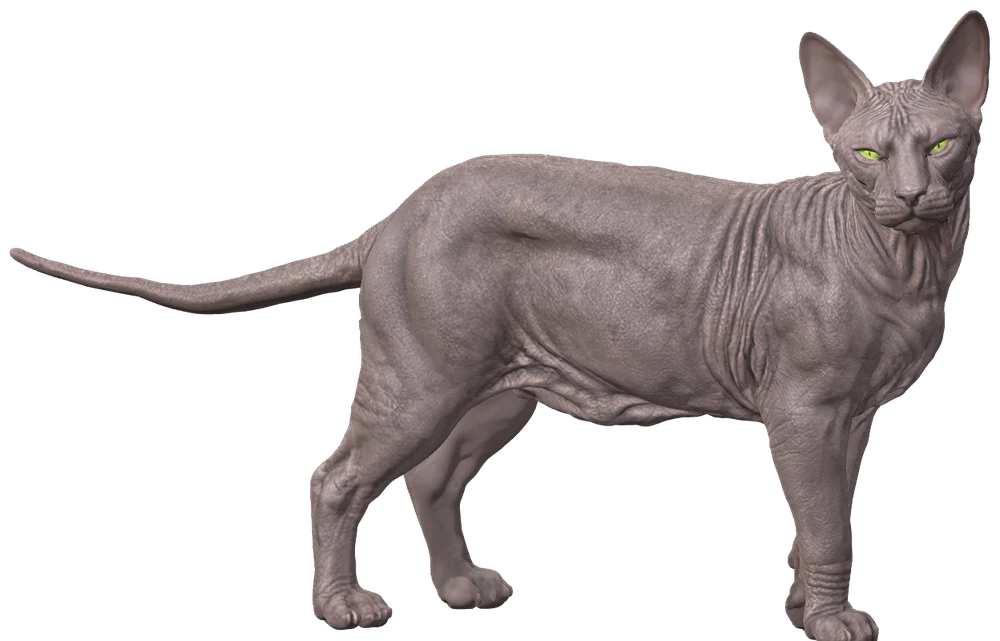
Under the bare skin is a medium-sized, muscular cat with a strong build. The head is triangular, with large ears and almond-shaped eyes that give the Donskoy an elf-like look, and the long, webbed toes are one of its signatures. The skin is very wrinkled, especially on the face, neck, chest and the base of the tail. Cats.com gives a height of 12 to 14 inches and an adult weight of 8 to 15 pounds; Catster gives 11 to 12 inches and 6 to 15 pounds.
05
Coat and colours
The Donskoy's hairlessness is caused by a dominant gene, unlike the recessive gene behind the Sphynx, so every cat that carries it is either born hairless or loses its coat as it grows. Breeders describe four types: the rubber bald, born bald and bald for life; the flock coat, born with a peach-fuzz coat that is usually lost; the velour coat, born with a short wavy coat and a bald spot on the head; and the brush coat, which keeps a wiry coat with bald patches and is the only type disqualified from the show ring. Some Donskoys grow a faint coat in winter that falls out again when the weather warms. Colour and pattern show in the skin, and eyes can be blue, green, amber, orange, yellow or brown.
06
Activity and play
These are athletic, playful cats with plenty of energy. A cat tree is a must, and the Donskoy loves its toys and interactive play sessions with its people, such as wand toys and lasers. Because it is so clever, it also takes well to training. With no coat to keep it warm, it also needs warm, soft places to rest, and it is known for cuddling up with family members, particularly during the cooler months.
07
Grooming and care
A Donskoy needs more care than its lack of fur suggests. The fine fuzz on the skin gathers oil, dirt and debris, so it needs bathing, and Catster suggests about every one to two weeks with a gentle shampoo made for sensitive skin and lukewarm water. Bathing too often or too rarely is the usual cause of skin trouble. The ears may need occasional cleaning, and teeth brushing and nail trimming are best taught from a young age. Keep your Donskoy out of strong sun, because the bare skin burns easily, and keep it warm, because it cannot tolerate cold. Cats.com suggests high-quality food, with extra omega-3 fatty acids to support healthy skin.
08
Health and lifespan
The Donskoy is generally robust, but there are concerns about the dominant mutation that causes its hairlessness. In its homozygous form it may cause feline ectodermal dysplasia, which can bring poor teeth and problems with sweating and nursing kittens. Skin problems are the most common everyday issue: the bare skin is prone to sunburn, which can lead to skin cancer, so time in direct sunlight should be limited. Dental care matters too. Both cats.com and Catster give a lifespan of 12 to 15 years. Regular vet check-ups, including skin and dental checks, are the best way to keep a Donskoy well.
09
Living with one
The Donskoy is an indoor cat that suits homes where someone is around a lot. Its gentle, sociable nature makes it a good fit for families with children, and it usually gets along with other cats, especially playful ones, and with dogs when properly introduced; its energy can be too much for an older cat. It barely sheds, which many owners like, though its skin still needs regular care. The breed is rare, especially in the United States, and some countries restrict breeding hairless cats on welfare grounds: since 2014 the Netherlands has banned breeding from parents that carry the hairless mutation.
10
Fun facts
Every Donskoy descends from a single rescued kitten, Varvara. The breed is named after the Don River, which runs through its home city of Rostov-on-Don. A Donskoy kitten can be born fully coated and go bald within its first year. Outcrossing is allowed only with the domestic shorthair. The Donskoy is often mistaken for the Sphynx, the breed that played Mr. Bigglesworth in the Austin Powers films, but the two are not related.
11
Questions about the Donskoy
Is the Donskoy the same as the Sphynx?
No. They look alike, but they are not related. The Sphynx's hairlessness comes from a recessive gene and the Donskoy's from a dominant one, so a Donskoy kitten can be born with hair and lose it as it grows.
Do Donskoy cats need baths?
Yes. The fuzz on their skin collects oil and dirt. Catster suggests bathing about every one to two weeks with a gentle shampoo for sensitive skin, in lukewarm water.
Are Donskoy cats good with children and other pets?
Usually, yes. They are gentle and sociable, suit families with children, and get along with other cats and with dogs when properly introduced.
Can a Donskoy go outside?
It is best kept indoors. The bare skin burns easily in the sun, which can lead to skin cancer, and the breed cannot tolerate cold.
How long do Donskoy cats live?
Cats.com and Catster both give 12 to 15 years. Good skin care, dental care and regular vet visits help.
12