
Dogs · Mac and Windows
Meet the Dalmatian.
The Dalmatian is the spotted athlete of the dog world, a dog bred to run for hours beside horses and carriages. Behind the famous coat is an energetic, people-loving companion that needs plenty of exercise and company.
Launch price $9.99, was $29.99
6 looks
Pick a look
Dalmatian
01
At a glance
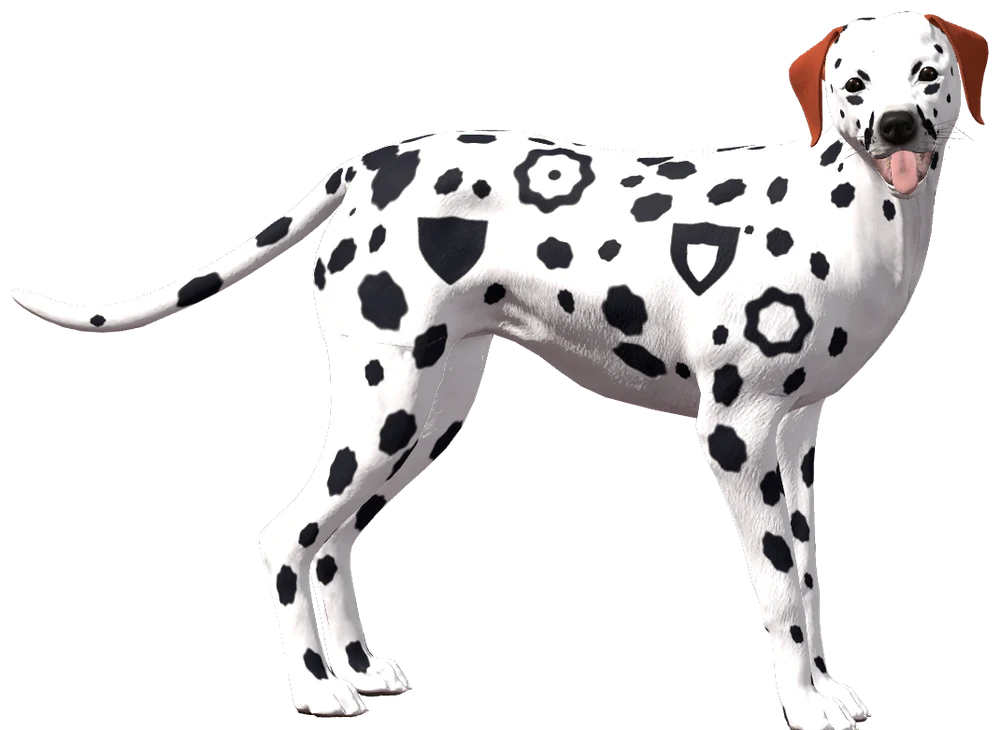
A large, short-coated, high-energy dog with a white coat covered in black or liver spots. Dalmatians usually stand about 48 to 58 cm at the shoulder, weigh roughly 20 to 27 kg and live around 12 to 13 years. They suit active homes where someone is around for most of the day. Sillmates makes the Dalmatian as a desktop pet companion for Mac and Windows, in the classic Black and Liver spots as well as Ember, Cherry Siren, Cobalt Alarm and Violet Watch coats.
02
History and origin
Despite the name, there is little evidence that the breed actually came from the Dalmatian coast of Croatia. In the late 18th century a white spotted dog was used in England to accompany horse-drawn carriages and guard passengers and cargo, and in 1791 the naturalist Thomas Bewick named this type the Dalmatian. During the Regency period it earned the nickname 'the Spotted Coach Dog'. Coach dogs trotted beside, in front of or even beneath the coach, keeping other dogs away from the horses. The same job carried over to horse-drawn fire engines, where Dalmatians ran ahead to clear the route, which is why the breed is still linked with fire stations today. The American Kennel Club recognised the Dalmatian in 1888.
03
Temperament and personality
Dalmatians are outgoing, playful and loyal to their families. Their working past shows in their stamina and in how strongly they bond with the people around them. They do not like being left alone: the PDSA recommends a home where someone is usually in, and says a Dalmatian should never be left alone for more than four hours. Bored Dalmatians can become restless, so steady, reward-based training and plenty to do keep them at their best.
04
Size and build
This is a large, muscular, balanced dog built for endurance rather than speed over a short distance. The American Kennel Club gives a height of 19 to 24 inches and a weight of 45 to 70 pounds, while VCA Animal Hospitals gives 19 to 23 inches and 40 to 60 pounds. In metric terms the PDSA puts the average height at 56 to 61 cm and the average weight at 18 to 27 kg. Males are usually a little taller and heavier than females.
05
Coat and colours
The coat is short, dense and sleek. The Royal Kennel Club breed standard colours are white with black spots and white with liver spots. One of the most charming things about the breed is that puppies are born white with no spots at all; the spots usually start to appear at around four weeks old, and every Dalmatian ends up with its own unique pattern.
06
Exercise and play
Dalmatians are true endurance dogs and the PDSA advises a minimum of two hours of exercise every day. Long walks, safe off-lead running, games of fetch and canicross-style jogging all suit them well. Mental exercise matters too: scent games and training sessions help use up energy that might otherwise turn into chewing or barking.
07
Grooming and care
The short coat is easy to look after with a weekly brush, but Dalmatians do shed, and white hairs show up on dark clothes and sofas. Regular brushing with a rubber mitt or short bristle brush keeps loose hair down. Diet deserves special attention because of the breed's tendency to form urinary stones, so ask your vet for advice on food.
08
Health and lifespan
The American Kennel Club gives a life expectancy of 11 to 13 years and VCA gives 12 to 14 years, so around 12 to 13 years is a fair expectation. Two breed traits are well known. Deafness can occur, and the Kennel Club runs a BAER hearing test scheme that includes litter screening; deaf dogs can still be trained with hand signals and vibrating collars. Dalmatians also process purines differently, and many form urate stones in the bladder. VCA notes that a diet low in purines, with moderate high-quality protein, can help, and that liver and other organ meats are best avoided. A DNA test for hyperuricosuria is available. The PDSA also lists skin allergies, epilepsy and hip dysplasia among conditions seen in the breed. Choose a breeder who health tests, and see your vet if you notice changes in urination, hearing or skin.
09
Living with one
A Dalmatian is happiest in an active household with a garden and owners who enjoy being outdoors. They can be good family dogs, but their size and energy mean play with small children should be supervised. Early socialisation helps them get along with other dogs and visitors. They are not a good match for long working days alone or for owners looking for a quiet, low-exercise dog.
10
Fun facts
Dalmatians are best known as fire dogs: they used to run behind fire carriages because they get along so well with horses. Their spots are not there at birth. No two Dalmatians have the same pattern of spots. They were named in print by Thomas Bewick back in 1791.
11
Questions about the Dalmatian
Are Dalmatian puppies born with spots?
No. Dalmatian puppies are born white and their spots usually appear at around four weeks old.
How much exercise does a Dalmatian need?
The PDSA recommends a minimum of two hours of exercise every day. They were bred to run beside carriages for long distances.
How long do Dalmatians live?
Around 12 to 13 years is typical. The American Kennel Club gives 11 to 13 years and VCA gives 12 to 14 years.
Are Dalmatians prone to deafness?
Deafness does occur in the breed. Puppies can be hearing tested with a BAER test, and deaf dogs can be trained with hand signals.
Why do Dalmatians need a special diet?
Many Dalmatians form urate stones. A diet low in purines, chosen with your vet, can help manage the risk.
12